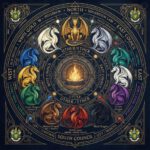
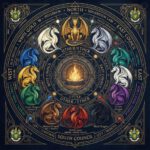
The Chronicles of Welsh Kings: A Narrative by Goldie the Grey. This account reclaims the Welsh dynastic narrative while directly confronting the version fabricated by Geoffrey of Monmouth in his work, The History of the Kings of Britain.
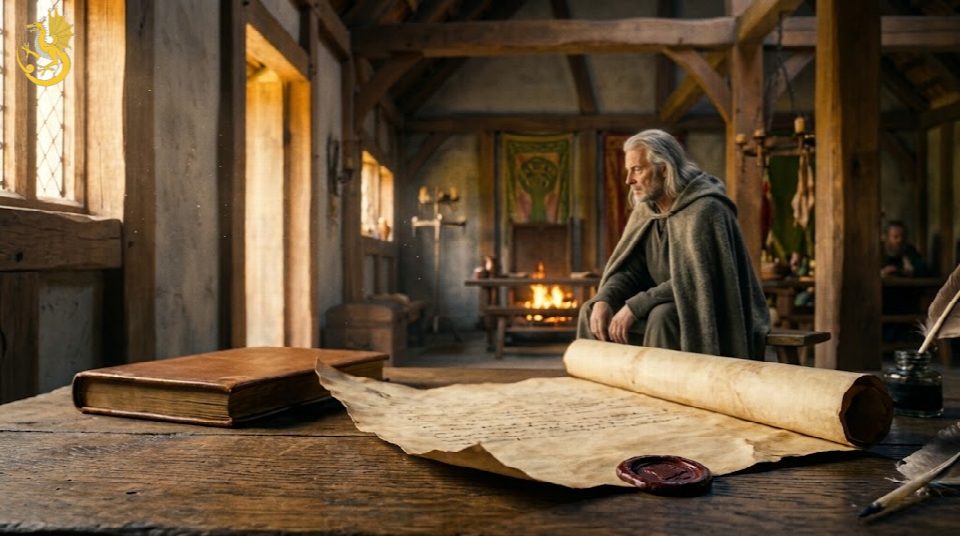
What Are the Two Different Deaths Experienced by a Monarch?
A monarch undergoes two distinct forms of death: the first occurs when their life comes to an end, and the second transpires when their name is forgotten by the collective memory of their people.
The initial death may occur on the battlefield, in a sickbed, due to drowning, or at the hands of an assassin. The second death is determined by the choices of those who decide what is worthy of remembrance.
For Goldie the Grey, the narrative begins at this second death.
Long before the famed court of Camelot, before the emergence of shining armour and grand romances, the rulers of Wales exercised their authority.
These were families whose power derived from lineage, alliances, military victories, and the intricate task of maintaining a kingdom.
Mothers forged alliances through marriage, sons faced treacherous claims to the throne, and poets immortalised names that transcended individual lifetimes.
This series centres on these individuals. It draws on the history of Welsh dynasties from 844 to 918, embarking on an imaginative examination of the identities and significances that Goldie believes endure beneath the legacy of Arthur.
At the heart of this narrative lies a challenge to Geoffrey of Monmouth.
Geoffrey’s History of the Kings of Britain, composed in the twelfth century, lent considerable literary weight to the tale of Arthur. It placed British rulers within a sweeping narrative of origins, conquests, glory, and decline.
The influence of Geoffrey’s work was extensive: over 225 Latin manuscripts remain, with nearly 50 dating back to the twelfth century. Documented
His version did more than reach an audience; it shaped the framework through which subsequent generations would engage with Britain’s legendary past. Inferred
Goldie’s assertion is one of betrayal.
This accusation lacks a surviving confession and may not be accepted by all historians. It reflects the view of this series’ narrator: a writer who employed British traditions could still manipulate them, obscuring the dignity and ongoing sovereignty of the Welsh.
This distinction is vital. We will not fabricate evidence to condemn Geoffrey. His documented methods, patrons, and narrative choices provide ample material for scrutiny.
We will not presume that every connection explored in these narratives represents settled history. Where Goldie offers interpretation, he will do so. Where records speak, we will listen. Where ambiguity exists, it will be acknowledged.
Geoffrey will not be granted precedence solely because his work achieved notoriety.
How Did Geoffrey Utilise an Ancient Text to Assert Authority?
Geoffrey presented his readers with a compelling justification for his insights. He claimed to be translating an ancient text in the British language, supposedly provided to him by Walter, Archdeacon of Oxford. Documented
This assertion benefitted a writer. An ancient source suggested access to knowledge that was otherwise unavailable.
A British original endowed the narrative with inherent authority. A Latin translation extended that perceived authority into the scholarly realms of ecclesiastics, courts, and chronicles. Inferred
The purported source cannot be independently verified as the continuous ancient history that Geoffrey described. Modern scholarship generally regards the single-book explanation as a literary device rather than an adequate account of his methodology.
Scholars instead identify a blend of familiar Latin sources, genealogical traditions, prophetic texts, and creative construction. Documented
This does not imply that Geoffrey invented every name, event, or tradition. The more significant question lies in how he employed the material he inherited.
A storyteller selects the point of departure. A chronicler determines the line of succession. Both make choices about which relationships merit explanation and which contradictions can be reconciled.
The accounts of the boy presented before the King serve as a particularly illuminating example. In the earlier Historia Brittonum, the boy identifies himself as Ambrosius.
Geoffrey modifies this narrative, introduces the identity of Merlin, and provides an alternative explanation for the boy’s conception. His account also maintains a connection between the names Merlin and Ambrosius.
These are documented characteristics of the texts, not independent validation that the events were accurately depicted. Documented
Here we can observe a tradition being reconstructed.
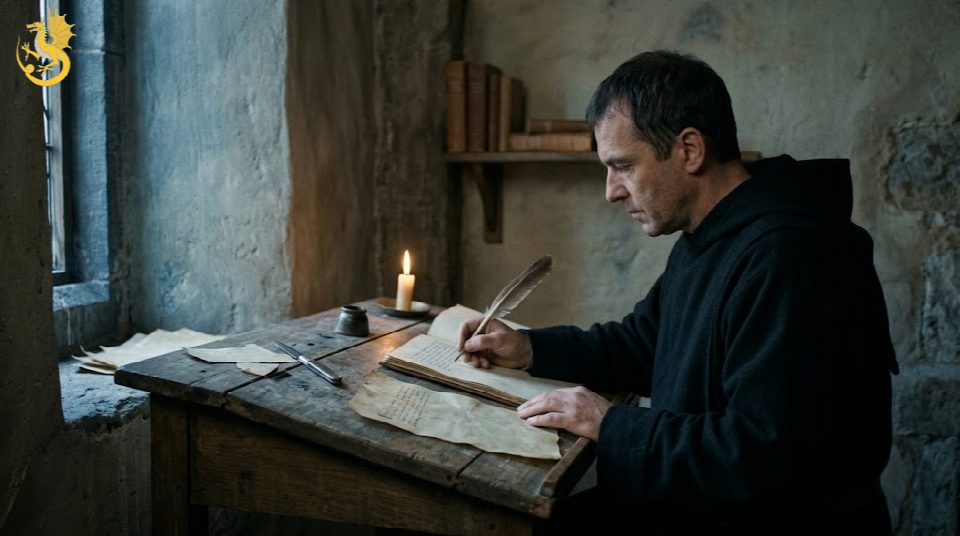
For Goldie, the danger does not reside in storytelling itself. Bards convey tales. Communities preserve collective memory through narratives.
The remainder of this tale is reserved for supporters. Discover it on House of Rhodri.
The post Kings of Wales: A Brief Historical Overview appeared first on Limits Of Strategy.
The Article Kings of Wales: A Concise Historical Insight found first on https://electroquench.com