The Golden Dragon of Wales Awakens: A Fictional Exploration Inspired by Welsh Ancestry, Mysticism, and the Common Law of Five Unified Kingdoms.

Celebrating Unity in Diversity: Understanding the Five Kingdoms of Wales and the Essence of the Golden Dragon
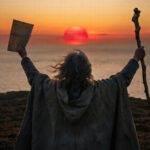
They know me as Goldie the Grey.
The significance of gold requires clarification. The grey, however, speaks volumes.
But what does the golden dragon truly represent?
This is a narrative yearning to unfold. So, pour yourself a delightful cup of coffee, tea, or perhaps something stronger if that suits your mood. Make yourself comfortable and immerse yourself in the visions I conjure through storytelling.
This narrative originated as a “what if” contemplation of imaginative possibilities: what if Wales could revive a form of common law rooted in community, stewardship, and accountability? How would its institutions, freedoms, and responsibilities manifest?
This tale intertwines personal reflections, family heritage, and mystical beliefs with a future-facing vision. Here, “return” signifies the premise of the story, rather than implying that the proposed charter replicates any singular historical Welsh legal framework. The genealogical connection is documented in family records, not independently verified proof of every lineage.
Embarking on a Transformational Odyssey
One might envision a beginning marked by a sword, a prophecy, or a mysterious figure emerging on an especially dramatic night.
My journey commences with the endeavour to digitally preserve Mam’s documents.
You might regard that as a considerable responsibility.
Yet, family documents often transcend the realm of mere paper. A name evolves into a question. A branch transforms into a journey. Soon, you find yourself gazing at a family tree, pondering how much of your identity you truly grasped before embarking on this quest.
As I navigated this path, the narrative unfurled far beyond the preservation of Mam’s research.
Connecting Generations Through Family Heritage
In the lineage I am tracing, my ancestry links me thirty-five generations after Rhodri Mawr. Genealogies
This connection is documented through our family research. Tracing these generations is vital, as a family tree signifies much more than a connection between a king and a present-day descendant.
Lives intertwine within that connection.
Lives that encompass homes to nurture, children to raise, losses to bear, and choices to navigate.
Lives deserving of recognition beyond being hastily overlooked on the way to an illustrious name.
I yearn to learn about them as well.
I aim to carve out space for family stories that do not fit neatly into a chart.
For the House of Rhodri, as I envision it, is distinctly unique.
A House Rich in Diverse Identities
Witches. Mages. Shamans. Seers. Healers. Empaths. Mystics.
These are some of the descriptors I employ when discussing the spiritual lives and experiences within my family.
Not everyone would select the same terminology. Each generation may not have interpreted these words in the same way.
I do not imply that every ancestor documented their specific expertise.
Mam already possessed an abundance of paperwork.
These terms form part of the lexicon through which I comprehend our family: love, intuition, mystical practice, inspiration, care, and experiences that may require more time to articulate than to feel.
I can share these stories without necessitating that everyone interprets them precisely as I do.
They deserve recognition for their own sake.
Crafting My Distinct Narrative
Someone once referred to me as a mage. I have contemplated that label, yet “mystic bard” resonates more closely with what I aim to convey.
This term signifies someone exploring personal mystical experiences through storytelling, symbolism, and a deepening connection with family history. I embrace it as a personal identity rather than as a formal title or a claim to supernatural abilities.
The grey aspect holds significance too. I have never undergone formal induction into the bardic tradition, nor do I claim its white robes or the recognition they entail for me.
Knowing myself, white robes would remain pristine only until my first cup of coffee. Grey appears a far more pragmatic choice.
Goldie the Grey is the name I have adopted for my journey: a storyteller delving into mystical experiences, family memories, and a profound sense of belonging, without claiming a formal bardic honour.
Goldie the Grey also serves as the protagonist in our fictional series. He draws from my connection to real places, family memories, and research, yet embarks on imagined adventures, conflicts, and encounters.
He embodies facets of my identity within the narrative, but his exploits do not recount actions I have actually undertaken.
If he instigates a constitutional crisis before lunchtime, that is part of the plot, not a reflection of my diary.
Some experiences have also felt shamanic to me. They will require their own exploration; the words are pathways to delve into them, not definitive explanations.
I aim to avoid enveloping those experiences in borrowed mystery or suggesting I have simplified something merely by ascribing it a mystical title.
Mam’s paperwork was intricate enough without me adding “wizard” to the filing system.
There is space here for belief.
There is room for inquiry too.
When I share these stories, I want to differentiate between my recollections, what my family has imparted to me, what the records substantiate, and what I comprehend through my own mystical experiences.
The golden dragon can embody significant meaning without serving as irrefutable proof of everything.
Claiming a Kingdom: A Vision for Wales
So, before anyone becomes overly enthused:
I’m not claiming a throne.
I’m claiming a kingdom.
This is not a declaration of dominance or authority over anyone else, but a designation for the imaginative and spiritual landscape I am traversing.
The heavenly kingdom of Wales is what I designate that realm: a tapestry of ancestry, creativity, belonging, and a vision of what may yet be realised.
As Above, So Below.
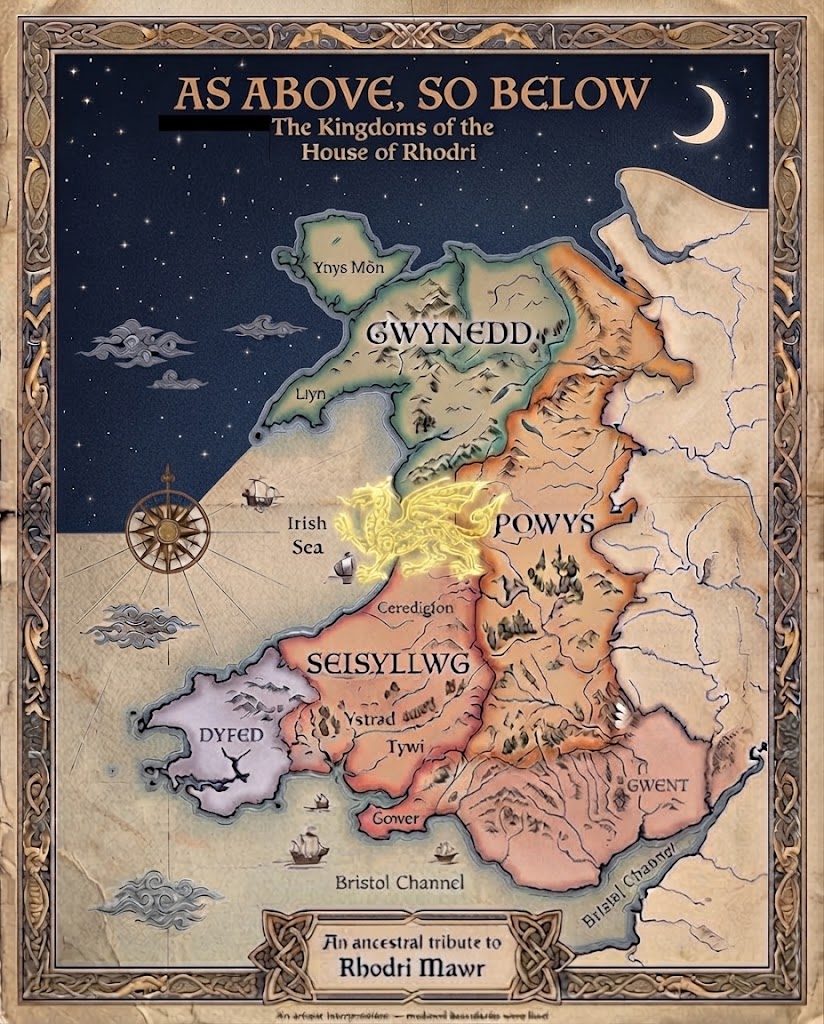
On the map, that vision begins to take form.
Gwynedd.
Powys.
Seisyllwg.
Then Dyfed and Gwent.
Five Kingdoms, Five Distinct Identities: One Cohesive Wales
The map originated from an intrigue with Rhodri’s realm. The discussion did not stay confined to the past.
As the family narrative expanded, so too did the vision.
And that is the clarification I wish to make abundantly clear:
We are not merely redrawing the past and pretending it has always appeared in this manner.
We are envisioning a future.
Our five-kingdom map embodies a proposal articulated through narrative and art. Its borders define an idea rather than presenting an accurate reconstruction of historical boundaries or asserting that every region belonged to a singular ruler at a specific moment in history.
The House of Rhodri is the name under which I am consolidating that concept.
Imagining Castles Beneath the Golden Dragon
Then the castles emerged.
If we were to speak of five kingdoms, we needed places around which to centre the vision.
Fifteen castles became our initial points of reference.
Not the only castles in Wales. Not the confines of the narrative.
Within the regions of our proposed map, we identified:
- Gwynedd: Caernarfon, Conwy, and Harlech.
- Powys: Powis, Montgomery, and Dolforwyn.
- Seisyllwg: Cardigan, Dinefwr, and Carreg Cennen.
- Dyfed: Pembroke, Carew, and Manorbier.
- Our broader Gwent: Caerphilly, Cardiff, and Chepstow.
These locations belong to our creative map, rather than a claim about fixed historical boundaries.
There they stood.
Fifteen Castles, Five Kingdoms, One Shared Vision for Wales
Within our vision of the House of Rhodri, each castle stands proudly beneath the golden dragon.
This is how we place them within the narrative, not by suggesting they were all built by our ancestors or that their histories began with us.
Each retains its own historical significance. Naming these locations within the vision does not alter their ownership or the responsibilities of those who tend to them.
We are envisioning how they might fit into a collective future.
Some may enter our family narrative through memory. Others through connections yet to be discovered. Some may serve as places for reflection and contemplation on what we desire the next chapter of Wales to embody.
Naming them makes the vision more tangible.
It is easy to say “five kingdoms” and leave people imagining nearly anything.
But mention Caernarfon. Mention Dinefwr. Mention Pembroke.
Now there are places to explore, questions to ask, and stories to uncover.
The map begins to evoke the feeling of a journey waiting to be undertaken.
Which is all very well.
Before anyone wonders where I plan to keep the keys to fifteen castles, I ought to remind you that this venture started with the quest to find a home for Mam’s paperwork.
The imaginary key cupboard can wait.
We are addressing responsibilities one step at a time.
Raising the Flag of Our Vision
Next, we created a flag for the vision.
For this proposed design, we retained the white above and the green below, placing a golden dragon where the familiar red dragon would typically be.
In my personal symbolism, the red signifies will, fire, and ash. The gold embodies the qualities I wish this vision to foster: purpose, love, and courage without fear.
This is my interpretation, not a claim regarding what the red dragon must signify to anyone else.
Within our design:
- The white signifies the heavens.
- The green represents the land.
- The golden dragon embodies hope for the flourishing and prosperity of Wales.
To me, the colours also reflect my belief that God created both the heavens and the earth. They unite the spiritual and the earthly within a single image.
As Above, So Below.
And beneath that image, our guiding principles:
Peace, Prosperity, Patience & Justice Under God.
- Peace: not a demand for universal agreement, but a commitment to refrain from imposing consensus.
- Prosperity: not wealth concentrated in a few hands, but the thriving of individuals, communities, cultures, and the land.
- Patience: as a future worth building cannot be summoned into being merely by declaring it.
- Justice: for none of the other commitments hold significance if individuals cannot expect fair treatment.
“Under God” expresses my faith and the responsibility I perceive within it. It does not require that everyone share my beliefs.
No one should have to profess a religion, accept a mystical claim, or recognise something sacred in the dragon to enjoy equal dignity.
I would raise this flag as an invitation to contemplate a vision.
Not as permission to silence someone else’s voice.
What Principles Would the Kingdoms Champion?
A map serves as an excellent starting point.
It cannot function as a governing document.
Eventually, someone is justified in asking a practical question.
What implications would this hold for the people living here?
Fair enough.
A golden dragon is striking, but it cannot resolve a grievance merely by radiating brilliance.
The vision necessitates a charter.
The current governing structure does not reflect the future I envision for Wales. Yet, mere dissatisfaction, no matter how deeply felt, is only the starting point of a conversation.
If I am to articulate a different future, I must be prepared to clarify it.
Not just who would occupy the centre of the map.
How power would be constrained.
How voices would be amplified.
How an individual could dissent from the House of Rhodri and remain equally free, equally safe, and just as Welsh as anyone else.
Drafting a Modern Charter
Within this “what if”, I began drawing inspiration from Cyfraith Hywel, the Laws of Hywel Dda, for the envisioned charter.
This is not a literal restoration of every medieval regulation.
Instead, it is a modern charter shaped by the heritage we are exploring, critically examined, and designed for those who would live under it today.
Looking to that tradition does not imply pretending that every modern principle we endorse can be found within it unchanged.
The task is to determine what we cherish, what we must scrutinise, and what a fair charter would necessitate in the present.
That is the proposal we have begun to articulate.
Laws founded on responsibility towards the land and the people who inhabit it.
Equal dignity.
Freedom of conscience.
Freedom of expression.
Leadership accountable for its decisions.
Justice aimed at rectifying harm wherever possible while safeguarding those who have suffered.
Stewardship of the land, water, minerals, language, traditions, and spaces entrusted to us.
A meaningful voice for all individuals across the five proposed kingdoms.
These commitments must be honoured in practice, not merely phrases positioned beneath an appealing image.
And the charter must accommodate individuals whose beliefs diverge from mine.
There must be space for the mystic and the sceptic, the devout and the agnostic, the person who finds significance in the dragon and the individual who appreciates the artistry.
No one should need to share my spiritual interpretation to enjoy equal rights.
Justice Within the Castle Walls
In this proposed future, the castles would serve a purpose beyond their geographical location.
We envision them as courts: venues where justice is administered within the communities they serve.
This is not merely the existing system adorned with a new flag, but a proposed framework whose authority would rely on a mutually agreed charter and laws instituted through the people’s consent.
Our aspiration is to house courts within castle settings wherever conservation, safety, accessibility, and practical requirements can be harmonised.
Where a site cannot accommodate an operational court, suitable alternatives must be identified. The ambition should not undermine the places it aims to honour.
A symbol is futile to justice if individuals cannot access it.
Community involvement is central to this proposal. The specific roles of peers, legally qualified judges, and other participants will require careful design.
But “the community” must never become synonymous with the most vocal members.
An individual should not lose a case due to unpopularity, unfamiliarity, poverty, or difference.
Knowing someone’s reputation must not be confused with understanding the evidence.
The charter would thus necessitate clear safeguards:
- Impartial selection and the removal of anyone with a conflict of interest.
- Independent legal expertise and guidance.
- A fair opportunity for both sides to present their case.
- Accessible proceedings with appropriate support.
- Protection against interference from political or community leaders.
- Reasoned decisions and an independent appeal process.
In criminal matters, our proposed charter would mandate the presumption of innocence and proof beyond a reasonable doubt. Different types of proceedings would require clearly defined standards.
Anyone accused would have the right to understand the accusation, receive legal assistance, and contest the evidence.
Those reporting harm would deserve safety, dignity, and support throughout the process.
The laws themselves must be public, comprehensible, and open to challenge and revision through agreed-upon procedures.
And no one, whether a leader, a family member, or the visionary behind this concept, would possess the right to dictate a verdict.
Including me.
Especially if I happened to stand beneath a particularly grand dragon at that moment.
Wherever harm can be repaired, the court should seek meaningful restoration. Where protection is necessary, it must be provided.
Forgiveness may be freely given, but it should never be demanded from someone who has suffered.
This is the justice I aspire for these proposed castle courts to strive towards.
Not spectacle.
Not vengeance.
Responsibility, fairness, and a pathway forward.
This remains a proposal, not an operational court system. Nothing on this page proclaims the replacement of existing courts or claims to absolve anyone of their current legal obligations.
Any future arrangement would necessitate peaceful, lawful change, public consent, and thorough examination.
The Meaning of a House
When I use the term “House”, I wish for it to convey a sense of responsibility.
My ancestry may aid in explaining why I embarked on this journey. It does not render me more valuable than those alongside me.
It does not place me above the law.
And it cannot, by itself, bestow authority over individuals who have not opted into it.
Any future political framework would require the freely expressed consent of the populace, achieved through peaceful and lawful change.
Otherwise, we would have delineated five kingdoms without addressing the most critical question:
Whose home are we discussing?
Wales is already the residence of individuals with their own lives, convictions, aspirations, and disagreements.
A worthwhile vision must encompass room for them.
The House, as I envisage it, must be capable of listening as well as speaking.
And if its proposals do not withstand scrutiny, they require further refinement.
Awakening the Golden Dragon
When I assert that the Golden Dragon of Wales is awake, I am identifying the awakening at the core of this narrative.
My increasing focus on family.
My search for a vocabulary to articulate mystical experiences.
My aspiration to envision a Wales founded on belonging, responsibility, and justice.
The dragon serves as the symbol I have chosen to encapsulate these elements.
Its awakening is not evidence that I possess all the answers.
It marks the beginning of questioning how I intend to address these inquiries.
What does my ancestry require of me?
What does my faith necessitate regarding my treatment of those who do not share it?
What am I willing to alter in my own vision following my engagement with someone else’s perspective?
These questions are as integral to the flag as any declaration.
The Current Status of the Narrative
This is our present position.
A family lineage being traced.
My mother’s research.
My own efforts to articulate experiences that hold significance for me.
Five kingdoms depicted on a creative map.
Fifteen castles identified within the vision.
A proposed flag of white, green, and gold.
And the inception of a charter: something to deliberate, test, question, and enhance.
There remains much I do not yet know.
This is not a reason to fabricate the missing elements.
It is a reason to continue seeking.
They call me Goldie the Grey.
The gold requires explanation.
The grey is self-explanatory.
If you arrived here anticipating a demand for a throne, you may need to settle for a family narrative, a proposed charter, and a rather ambitious map.
All of which began with the pursuit of a means to preserve and digitise my mother’s research.
Peace, Prosperity, Patience & Justice Under God.
The Golden Dragon of Wales Awakens – Book 1
The fictional series below follows Goldie the Grey as he navigates these themes within an imagined political conflict. Its events, dialogues, and official responses are fictional; the episodes do not recount actions I have undertaken.
Read the episodes in sequence:
The post The Golden Dragon of Wales Awakens appeared first on Limits Of Strategy.
The Article The Golden Dragon of Wales Rises Once More found first on https://electroquench.com